There is a short list of golf destinations worth the time, patience and money required to travel halfway around the world to enjoy.
Mission Hills Resort Haikou on China’s tropical Hainan Island is one of those places.
“It’s like China’s Hawaii,” says golf course architect Brian Curley. “It is 100% worth the trip.”
The massive resort — which takes more than 20 minutes to traverse by car from one end to the other — features 10 golf courses built on a dramatic volcanic rock landscape. That ride must seem like a blink compared to the 24-hour door-to-door trek it takes from most locations in the United States.
What makes this resort unique is that all the layouts were designed by the Arizona-based Curley, including the famous Blackstone Course.
The colossal undertaking, which began in 2006 and took Curley and his team a remarkable 30 months to complete, helped launch his solo career across Asia and beyond after leading the Landmark Golf Design office.
“There’s a certain feeling of accomplishment when you take a property that has no business being a golf course and turn it into world-class golf,” Curley says of the lava-strewn location in China.
Creating a blanket of playable turf was helped by a discovery 10 miles away: a large hill of clay.
“We just whittled it down and trucked it in,” Curley says of the capping process over the lava bed. “It was running 24 hours a day, with 2,000 trucks bringing in the material. Basically, anywhere you see turf, there’s a meter of this material on top of it that we trucked in.”
Curley soon came up with another design concept that originated from the property’s sand source.
“The lava stopped at the river where we were getting our sand. I said, ‘Wait a second, why are we paying more for material? Why don’t we just do all the capping in sand? And while we’re at it, let’s just do a sand dunes course on top of the lava rock because it’ll be different, right?’”
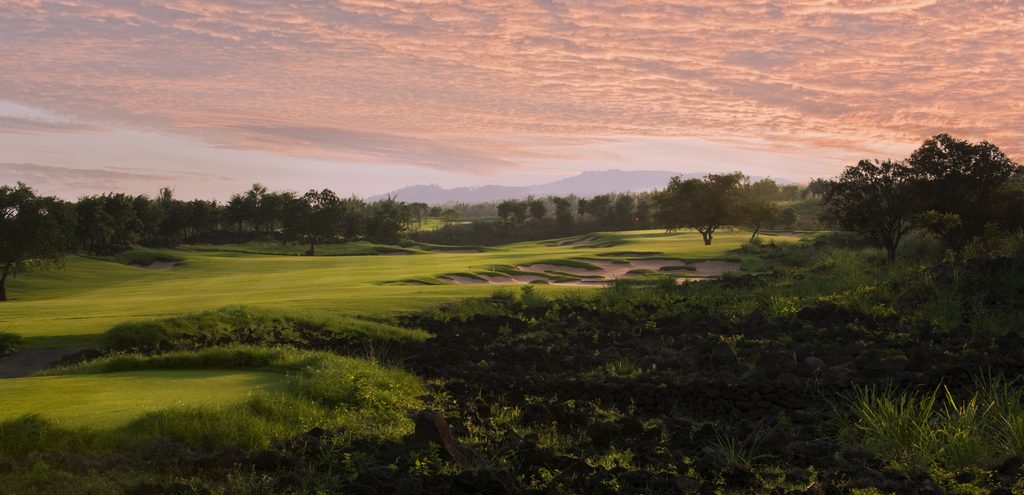
So the final course of the 10 was called Shadow Dunes.
“It looks like it’s at the beach. It’s all sand,” Curley says.
The property features 99 distinct water hazards and natural winding waterways alongside more than 150 hot and cold volcanic mineral spring pools.
Ken Chu, known as “Mr. Golf” in China, is now the chairman and CEO of Mission Hills Group, which includes the original Mission Hills on the mainland — recognized as the world’s largest golf facility with 12 courses.
Curley became close with Chu’s father, Mission Hills founder David Chu, in the early 1990s as he began design work there for Landmark, leading to his foray into the island project.
“For some reason, Dr. Chu loved me,” Curley says. “So things kind of mushroomed on and on and on.”
Golf was so popular in China at the time that the elder Chu floated an idea that seemed incomprehensible to Curley.
“We were on a bus with a bunch of these Mission Hills executives, even a feng shui consultant,” Curley recalls. “We started looking at all these properties because Chairman Chu wanted to build 36 courses at one time. Not 36 holes, mind you, but 36 courses.”
Part of that collection of 36 courses became the 10-course Mission Hills Resort Haikou location. The others reached various stages of design, Curley says, before land disputes and a contraction of the Chinese golf market halted development.
Traveling so far to play several courses designed by the same architect may not seem attractive to everyone, but Curley created what he calls “a war room” to mull over different design ideas in order to make each of the 10 courses memorable.
“At the time, we were thinking we were going to be doing 36 courses, so even though you might like Pine Valley, you don’t do 36 Pine Valleys,” Curley says. “It was like an instant study in how you make courses look different, play different, appear different.
“We just had a big old table and we started categorizing things — like, here’s an Augusta look; here’s a Pine Valley look; here’s a National Golf Links look. It was wild.”
As the process unfolded, Curley said coming up with concepts and ideas was the easy part of the massive undertaking.
“The hard thing was having shapers on one course one afternoon and then tomorrow having them on another course with entirely different concepts,” Curley says.
In the end, Curley’s team was able to achieve the variety it sought, which is an attractive selling point to those traveling there for a five-star dining, golf and lodging experience.
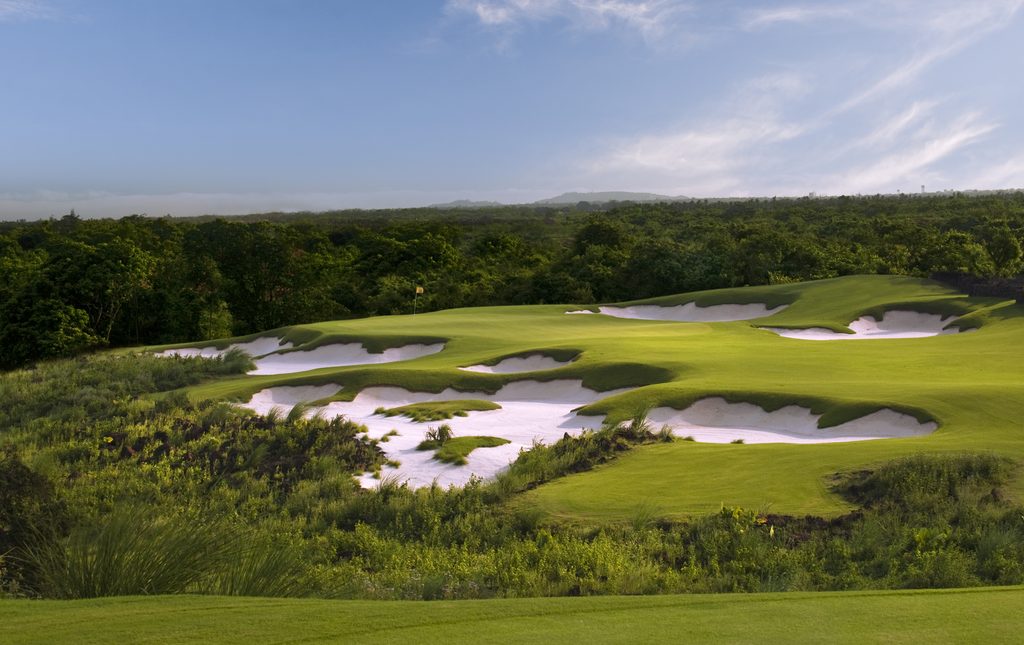
“We tried to push the extremes,” Curley says. “We went from small greens to big greens to super-crazy greens. We did anything and everything. There are what we call in the business template courses, but these are not. They are much more different in Haikou than they are at Mission Hills Shenzhen/Dongguan because we were so limited by the property there. Haikou was more of a blank slate, so as long as we could put dirt down, we could do just about anything.”
Curley says the design ideas included what he termed “wacky stuff.”
“We got photos from courses that were built at the turn of the century, with horse and plow, and made all these weird mounds and all that kind of stuff they did back then. We really tried to make something that was old-school-looking. I think we checked all the boxes with this project.”
One of the 10 layouts is called the Double Pin Course, which is a collection of 18 par-3 holes. There are two pins on each of the greens, which are designed to offer one accessible location and one much more difficult.
It costs roughly $300 to play the 7,808-yard Blackstone Course, which has been voted the best championship venue in Asia.
“If some of these courses were in the States, they would just kill it,” Curley says.