
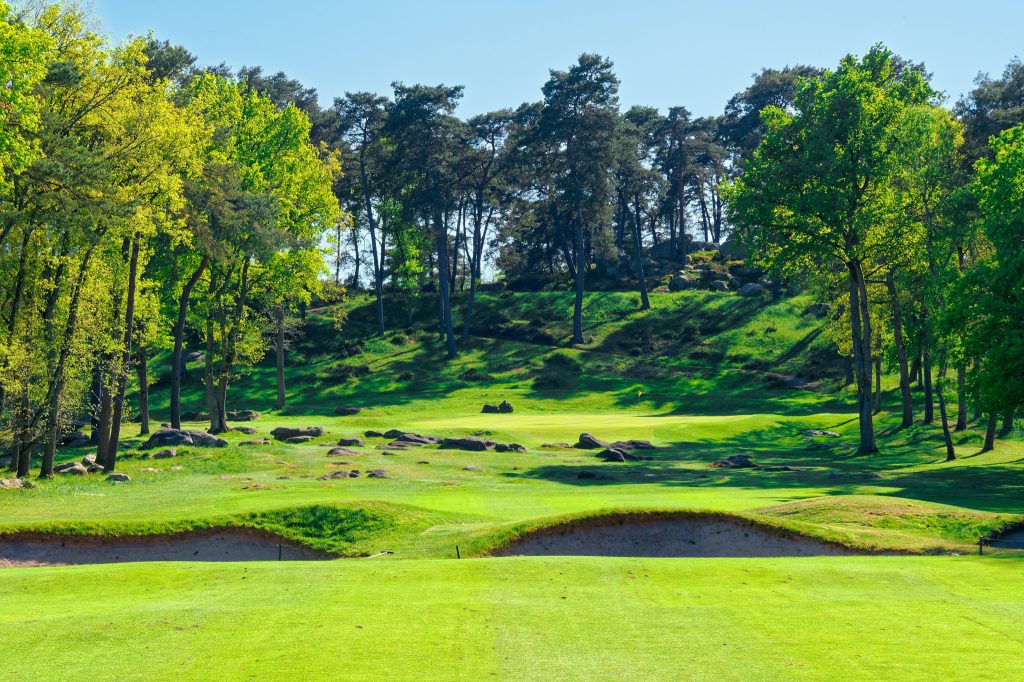
Nestled southeast of Paris, near the historic grandeur of Fontainebleau Castle, lies a course that consistently ranks among the top 10 in Europe. Golf de Fontainebleau is more than just a sports venue, it is a cultural landmark where the Golden Age of golf design meets a commitment to modern excellence.
Originally founded in 1909 on the initiative of Marquis Jean de Ganay, the course has seen the hands of legendary architects, most notably Tom Simpson, who reshaped the layout in 1920. Today, his signature style still dominates the landscape. To preserve this heritage, the club recently completed the first phase of an ambitious renovation led by Clayton, DeVries & Pont, featuring German architect Hendrik Hilgert and his colleague Frank Pont.
The overall idea behind the project was restoring the “Simpson Spirit.” The restoration focused heavily on returning the course to its roots, specifically targeting the bunkers on numerous holes. By restoring the laced bunker edges typical of Simpson’s work, the team successfully harmonized the classic design with the rugged, natural environment.
The course is a heathland layout characterized by sandy soil, ancient pine forests and vibrant heather. The sandy base ensures excellent drainage, making the par-72 course playable in nearly any weather.
The course’s highlights of the round start immediately with the par-4 first hole, a deceivingly simple start. Players must clear a chain of bunkers crossing the fairway to reach an elevated green that slopes significantly toward the front. The 181-yard par-3 second was part of the recent renovation. Framed by forest, this hole requires a high approach to avoid a hill on the right and a deep green-side bunker on the left. Players get a full taste of the course by the par-5 third hole, which features tees integrated into the iconic rock formations of the region and offers a dramatic downhill drive.
The fourth hole is another highlight on the front nine and is often cited as the toughest on the course. This dogleg right demands precision between fairway bunkers and a tall tree to reach a green that falls away sharply at the back.
On the back nine, the 12 hole is a short par 5 at 454 yards, and is arguably the most beautiful hole. It requires players to navigate a row of bunkers with high lips and the club’s signature rock outcrops. Before reaching the clubhouse, the shortish par-4 17th hole is the easiest on the scorecard. It tempts players with a narrow entrance to a long green guarded by bunkers.
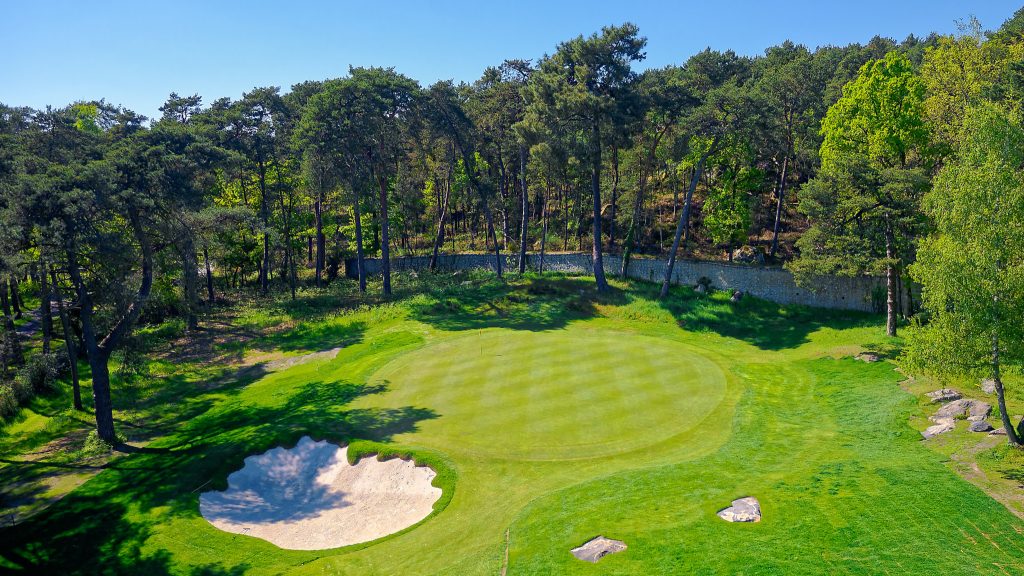
The club’s location is steeped in environmental history. The surrounding Forest of Fontainebleau was declared the world’s first nature reserve in 1861. Consequently, the club is a dedicated participant in the French Golf Federation’s biodiversity program.
The off-course experience is equally refined. The Norman-style clubhouse features frescoes by Paul Tavernier, a member of the Barbizon School, reflecting the area’s rich artistic heritage.
After the round, a visit to the famous Chateau de Fontainebleau is a must. The legendary castle stands as a monument to French history, its immense significance underscored by its proximity to one of Europe’s premier golf courses.
This architectural jewel is inextricably linked to the natural beauty of the surrounding Forest of Fontainebleau, famously declared the world’s first nature reserve in 1861. Here, visitors encounter a rare fusion of royal history and sporting excellence within a protected landscape southeast of Paris.
Additional excursions may lead to the French capital, which is about an hour’s drive. And while in Fontainebleau, one should not miss to enjoy the extraordinary French cuisine, which can be found all over the city.