
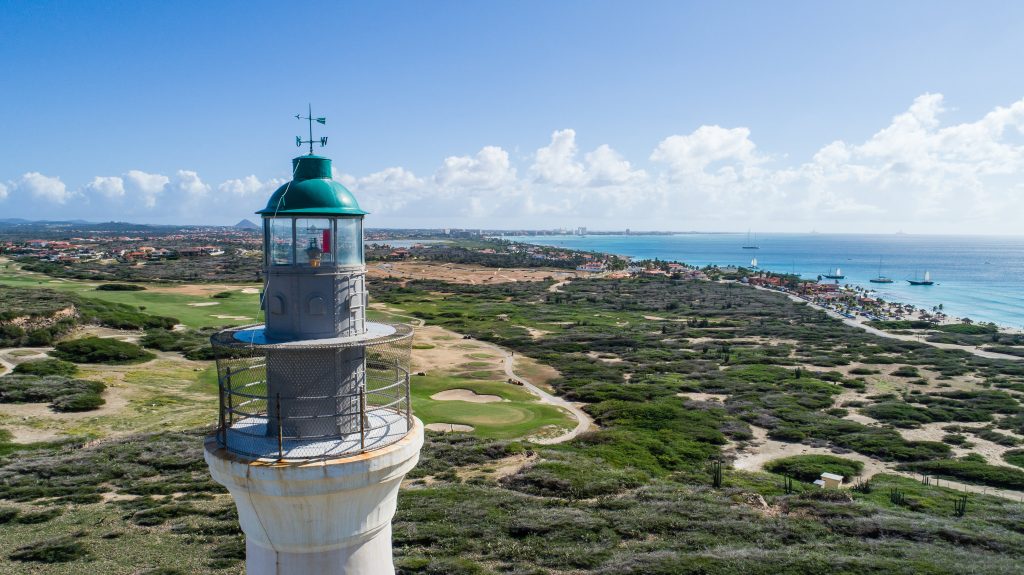
Packing your favorite swimsuit and plenty of suntan lotion were givens over the years when heading to Aruba, but the golf clubs not so much.
The latest renovation to Tierra del Sol Resort & Golf Course – still the only 18-hole layout on “One Happy Island” – may change one’s thinking.
Opened in 1995, and three years later played host to a Shell’s Wonderful World of Golf match between Nick Price and the late Payne Stewart, the course designed by architect Robert Trent Jones Jr. had fallen off the radar for many Caribbean golf enthusiasts on an island where windsurfing – not necessarily golf – is king.
Situated on the west coast near the island’s trademark white sand beaches and iconic California Lighthouse, Tierra del Sol by Iberostar has reopened following a 13-month renovation project in partnership with the GEO Foundation for Sustainable Golf, positioning itself back on the Caribbean must-play list.
The redesign featured sweeping bunker reduction and reshaping, total irrigation replacement, 18-hole tee and green restoration and an expansion of already extensive Shoco Owl nesting habitats.
The Shoco Owl is the national bird of Aruba, where development across this island nation has resulted in a marked loss of natural habitat.
The course’s location has long been a stronghold for Shoco Owl breeding pairs. The recent restoration increased the number of on-property nesting sites by 80 percent, says Tierra del Sol general manager Ashiko Martinus.
Jones and his architectural firm were very active with other designs across the Caribbean when he was approached in the mid 1990s to build a course on a unique piece of land in Aruba.
Jones chuckles when asked about his first visit to the island.
“Everybody was windsurfing in those days, and everybody was on the ocean,” Jones says. “I immediately thought to myself, ‘I’m going to have to take the invisible hazard into account here.’ What’s the invisible hazard? It’s the wind. And there was lots of it. So, basically the course had to be laid out in a linear way, from north-to-south and then east-to-west, running with the wind or against the wind.”
Jones quickly got off the land and headed into the ocean, too. Not to swim at stunning Palm Beach though.
“You don’t see the wind, you feel the wind,” Jones says. “So I got out on a boat so I could feel the wind and then looked at the land.”
With the island’s strong trade winds able to roam freely, the desert landscape also provided panoramic views of the sea and sandy formations that often translates to a challenging round.
Golf Digest once described Tierra del Sol as playing Scotland, Arizona and the Caribbean all in one round.
“I’m not into one thing when I design courses,” Jones says. “I’m more like a composer of symphonies. I like different moods, different things. But obviously the sea is nearby as a backdrop, and you have some salt marsh and inland holes. You have a variety of different moods, but the wind is everywhere. It’s always present.”
The tropical environment in Aruba is warm but not lush, an environmental mixed bag when it comes to disease suppression, punishing storm seasons and briny irrigation reserves. What’s more, “sustainability” simply wasn’t a thing 30 years ago. When the resort was ready to renovate, it reached out to GEO Foundation for guidance.
“We recognized the need to reduce water consumption, improve turf quality and enhance biodiversity across the course,” Martinus says. “Another key renovation was upgrading our irrigation system for better water efficiency — but we also introduced drought-resistant grass varieties and restored several additional natural habitats to support local wildlife.
“All of these efforts align with our commitment to environmental stewardship and ensuring that the course remains in top condition for generations to come,” he added. “While the current renovation focused on the course itself, we are also looking at enhancing our other golf facilities, improving practice areas, and hosting special events that highlight the natural beauty of Tierra del Sol.”
Jones notes that golf is a relatively modern idea in the Caribbean.
“Most of the Caribbean is a mixture of European countries that didn’t play golf,” Jones says. “It didn’t have a cultural history of that as a sport. It’s mostly ocean sports like sailing or scuba diving or fishing or windsurfing. It has changed somewhat with all the American’s vacationing there now.”
Jones, who has designed close to 300 courses in his illustrious career, says it’s sort of a badge of honor that Tierra del Sol remains the only 18-hole layout on Aruba.
“If I was a military man I would put a ribbon on my shirt,” he says. “Aruba is a colorful place and I love the vibe there.”
Tierra del Sol has numerous homes to rent of varying prices, many of which include built-in pools and are a short walk to the award-winning beaches or snorkeling.
And most have a view of either the sea or the golf course – or both.
It’s hard to break away from the island’s sunshine, warm waters and Argentine beef, but Jones recommends playing Tierra del Sol more than once when on vacation.
“It’s kind of like you don’t know the character of a woman sitting at the bar so you better dance with her a few times, talk with her,” Jones says. “Same with this golf course, you can’t judge the first time you play. Play it a few times, and if you’re in a match you’re going to be able to take advantage over anybody who doesn’t pay attention to her character, the wind and the changeability.”