I have been fortunate enough to play some of Alister MacKenzie’s greatest golf courses. Augusta National. Cypress Point. Crystal Downs. They are all very difficult courses built on very different pieces of land, but each has the unmistakable fingerprints of the same man.
As great as these three courses are, however, there is a problem with them: Most golfers will never get past the gates they lie behind. That is part of what makes Pasatiempo Golf Club special. Anyone can play it.
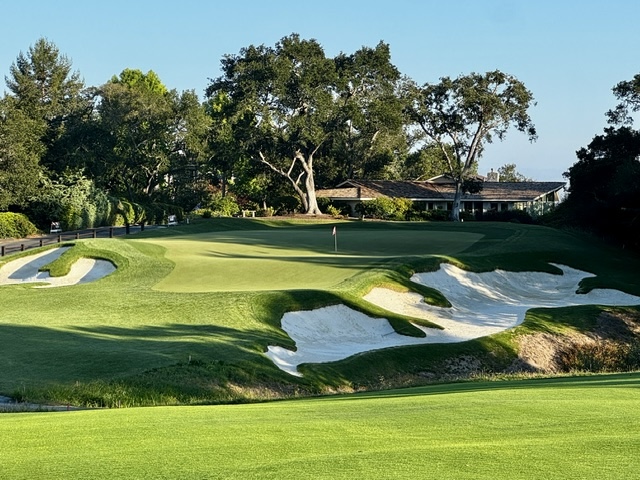
Pasatiempo is routed along the hills above Santa Cruz, California, overlooking Monterey Bay. It opened in 1929, and MacKenzie thought enough of the place to build his own home alongside the sixth fairway. I’ve heard that Bobby Jones played Pasatiempo shortly after it opened and was so impressed that it led to his bringing MacKenzie into the project for the course that became Augusta National.
Now, Pasatiempo has undergone an extensive restoration to reveal the original intent of MacKenzie. Time, nature and man’s hand have altered the natural land movement and green contours. Much of what makes Pasatiempo special is what you feel under your feet as you walk the course.
Justin Rose once said something to me about golf course architecture that has stuck with me: When the ball is in the air, every golf course is essentially the same. What distinguishes one from another is what happens when the ball touches the ground.
I thought about that while standing on the 14th fairway at Pasatiempo. As I looked at the image of the hole on my Garmin watch, it appeared to be a fairly conventional par 4. But as I stood in the fairway, I saw something entirely different. The ground looked like it was moving.
The ground rises and falls across the hole like waves sweeping across the surface of the ocean. A barranca runs through the fairway. My ball flew through the air, then landed on a piece of ground that had something to say about where it went next. The ball came to rest on a ridge on the right side of the fairway, leaving 173 yards to the hole.
The 14th fairway is perhaps the most dramatic example of the land movement, but the barrancas are everywhere. Sometimes you play alongside them. Sometimes you cross them. Sometimes they influence how you play your approach to the green. MacKenzie didn’t treat them as nuisances. He made them part of the golf.
It’s the type of architectural thinking I saw when I played Shoreacres, Seth Raynor’s marvelous design outside Chicago. What fascinated me there was the way Raynor incorporated the property’s natural ravines, requiring golfers to play alongside them, across them and through them. I considered his use of the ravines to be genius.
At Pasatiempo, MacKenzie does much the same thing with the barrancas. Two different natural features. The same idea. Don’t fight what the land gives you. Make it part of the golf.
Preserving that genius, however, presented Jim Urbina with a different challenge when he undertook the restoration of Pasatiempo.
I live in a house in Philadelphia that was built in 1800. Over more than two centuries, the house has been modernized. Electricity, plumbing, heating and air conditioning were added, much of it inside the walls. Kitchens and bathrooms were updated. All of it was necessary if you want to live comfortably in a house built in Philadelphia’s last year as the nation’s capital.
But modernization comes with a cost. Each improvement creates an opportunity to erase a little of what made the old house special in the first place.
Using historic photographs, aerials and physical evidence, Urbina and his team worked to recover elements of MacKenzie’s design that had disappeared. Urbina addressed this by putting all the modern features underground while recovering MacKenzie’s contours, green edges and green-complex bunkering.
He modernized the course without modernizing the architecture. He didn’t erase MacKenzie’s wrinkles. He brought them back.
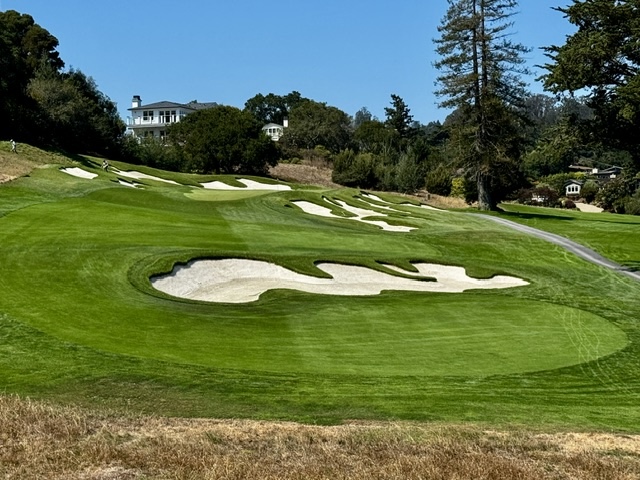
This is seen throughout the course, but nowhere more dramatically than at the 16th hole. The hole crosses a barranca before climbing toward one of Pasatiempo’s most extraordinary green complexes. Urbina and his team completed the front nine to gain experience before taking on the green complexes on the back nine.
Their work paid off with what I saw as I studied the 16th hole during my round. The barranca, bunkers, elevation and green weren’t separate features. They all appeared to work together to illustrate MacKenzie’s genius.
He wasn’t just asking me if I could strike the ball well. He was asking me to decide which golf shot I should hit, where to land it and what I expected the ball to do once it touched the ground.
For the best angle to a front-right pin, I aimed for the right side of the fairway off the tee but pulled the ball. It landed on the left side of the fairway and rolled to the left edge. Now I had to take on the left-front bunker with my 9-iron approach shot. The bunker won. Fortunately, I was able to get up and down to save par.
So, call the pro shop and book a tee time. An invitation is not necessary to experience some of the finest architecture from golf’s Golden Age.
Just get yourself to Santa Cruz.