
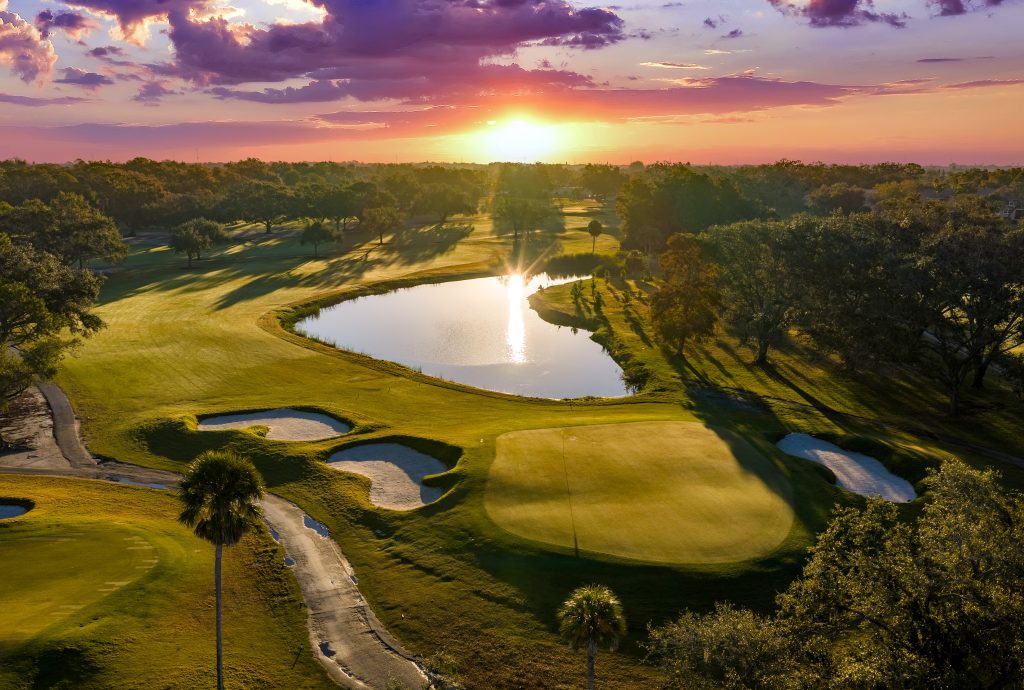
The city of Dunedin, Florida, northwest of Tampa, is hoping a buried treasure unearthed beneath Dunedin Golf Club will bring thousands of visitors to the picturesque Gulf Coast town.
The treasure: an original 1927 Donald Ross design hidden by almost 100 years of alterations and deleterious maintenance practices.
Ross, a giant of the Golden Age of golf architecture in the early 20th century, called the 6,766-yard, par 72 course one of his finest works, at one point calling it his “masterpiece.” He praised its “ideal combination of rolling hills, waterways, and natural hazards.”
Gene Sarazen, who played Dunedin almost daily in 1928, proclaimed it, “the best course on Florida’s west coast and one of the best in the entire South.”
Restoration of Dunedin started in February 2023 and reopened in late November 2024, although delayed by Hurricane Helene in September 2024 and Milton a month later. It was awarded Golf Inc. magazine’s first-place award for public-course renovation of the year for 2025.
Visitors can now play a course that its restorers say is 97 percent of Donald Ross’s original vision, with Ross hallmarks of false fronts, undulating greens, bunkers deceptively placed 30 to 40 yards short of the green and an emphasis on strategic use of fairway width and angles.
Cost for non-residents is between $110 and $140, depending on the season. Dunedin Golf Club is about 40 minutes from Tampa International Airport.
For the Dunedin’s restorers — a who’s who of Donald Ross restoration experts — the project was something akin to an archeological dig. Armed with Ross’s field notes, original drawings and elevations, the team scraped away several feet of earth atop the original greens, stopping only when they found a layer of cinders – a material that Ross used as the base of his greens.
From there, they consulted original drawings to recreate the 1927 green contours. Greens were returned to their original square footage. The shape and depth of greenside bunkers were restored and some 43 of the original 114 bunkers that had been removed over the years were restored, bringing the course’s bunker count to 87.
In very few cases, in recognition of the faster green speeds that modern recreational golfers expect, a few greens’ slopes were reduced from their designed 4 percent, which would be close to unplayable if mowed to today’s standards.
Blair Kline, a PGA professional with 40-plus years in golf management, construction, grow-in, and restoration, was brought on by the City of Dunedin in 2023 to oversee the restoration. Donald Ross restoration expert Kris Spence of North Carolina, who had restored 23 Ross courses, was called in, as was TDI Golf, a Canadian engineering company that had worked on some 30 Donald Ross courses.
“Kris Spence handled the architectural work,” Kline said. “We considered two firms — one more engineering-based, one architectural — but Kris was selected largely because of how intimately he knew the golf course. He knew the holes by name. Their lead shaper, Ron Hart, is a Donald Ross expert. Watching Kris and Ron work together honestly felt more like archaeology than construction.’
“They uncovered the original 1926 green pads, guided by Ross’s original field notes from Tufts University. These are not replicas — these are the original grades, rebuilt with modern drainage and turf.”
Spence said that as soil that had built up from top-dressing through the years was removed, “You could see the original greens and their contours. We could see that they had been built exactly to Ross’s specs on the drawings.”
The course, originally named Dunedin Isles Golf Club, opened as a private club but fell on hard times and closed for a few years. It was bought by the city and leased back to the club. Through the years, although it was technically semi-private, tee times for non-members were so scarce that for all intents and purposes, it remained a private club.
Today, members of Dunedin Golf Club are considered prepaid greens-fee players who can book tee times 10 days in advance; non-members can book seven days in advance. To ensure public access, the golf club’s membership is capped at 275, although there are 228 on the waiting list.
The restoration cost $6.3 million. The money came from a state historical grant, a small donation from the Donald Ross Society and from a Covid-era federal grant. The rest came from a bank loan backed by revenues from the golf course, which operates as a self-sustaining city enterprise fund.
Dunedin has a significant place in golf history as the winter home for early Tour pros, and it was the first home of the PGA of America. From 1948 to 1962, when it was known as PGA National, it hosted 18 Senior PGA Championships.
In 1954, the first PGA Merchandise Show – which now draws tens of thousands of people annually to the Orange County Convention Center in Orlando – was held in the club’s parking lot.